There is something quietly deceptive about Cowley Tunnel. You approach it along the Shropshire Union Canal, the water rippling gently in the breeze, the hedgerows soft and forgiving, and then the land suddenly tightens, the earth rising sharply, closing in, as though the countryside itself had been sliced open.
And in a way, it was.
The Ambition: A Straight Line Through Difficult Ground
In the early 1830s, the canal engineers (under the formidable eye of Thomas Telford) were driving a bold idea through the English landscape: a fast, efficient waterway linking Birmingham to Liverpool.
No wandering, meandering medieval canal here. Telford wanted straight lines, speed, and engineering discipline.
Cowley was meant to be one such triumph.
Originally, the tunnel was planned to stretch for around 690 yards - a proper subterranean passage, driven deep beneath the Staffordshire soil.
But Mother Nature - and the earth in particular - had other ideas.
“It Won’t Stand, Sir…” – When the Earth Fought Back
Work began around 1830–1831, with navvies cutting in from the northern end. It was tough work, but paid well.
At first, progress was steady. Rock was encountered, and the tunnel began to take shape.
Then the walls started to move.
The sandstone and marl here were friable, crumbly, unstable, treacherous. Instead of holding firm, the tunnel roof threatened to collapse. Engineers faced a stark choice: either shore it up at immense cost and risk, or abandon the original plan and divert the canal via a different route.
They chose a compromise.
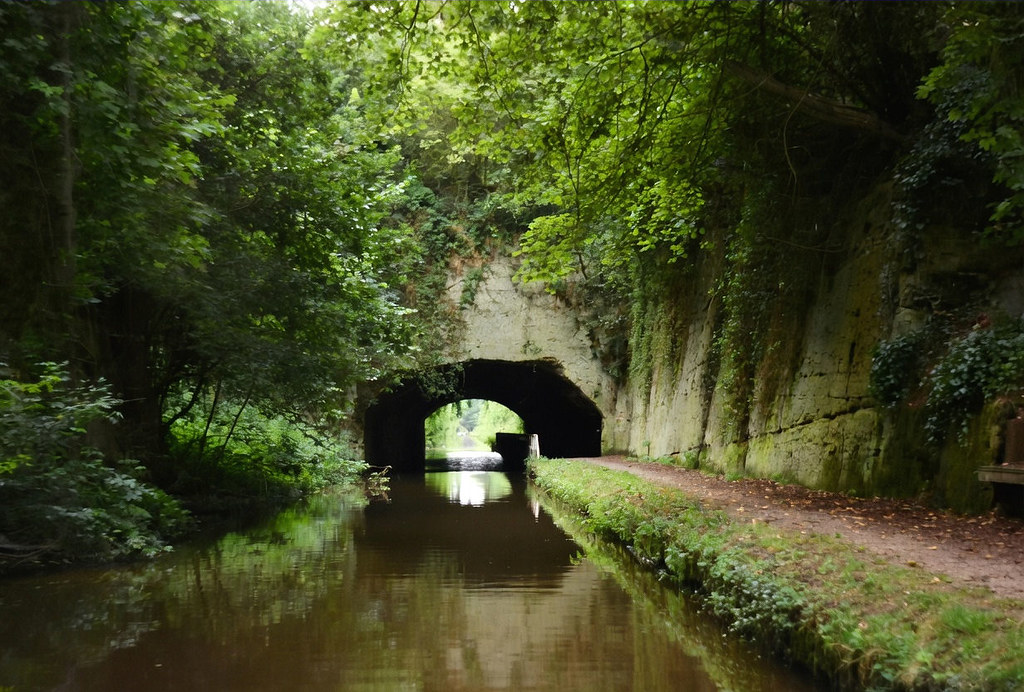
Only the first 74–80 metres of the tunnel survived as a true tunnel. The rest was opened out into what we now see: a deep, steep-sided cutting, carved brutally into the land.
You can almost imagine the conversation between the navvies at the front, and the foreman standing behind them, examining their options:
“It won’t stand, sir.”
“Then cut it back.”
“All of it?”
“Aye… better a scar in the earth than men buried in it.”
The Navvies: Lives Cut as Hard as the Ground
Behind every yard of canal lay the labour of the navvies (short for “navigators”) the itinerant workforce who built Britain’s waterways.
They were not local men.
They came in gangs - Irish, Welsh, English - following work from one vast project to another. Temporary huts, rough encampments, muddy boots at the edge of polite society. At the time there were around 50,000 navvies working on the canals, and under very, very difficult conditions.
Life was hard. Dangerous. Collapses were common, injuries frequent, and pay inconsistent. The discipline would have been harsh.
In places like Gnosall, their arrival caused unease. There is even evidence that rising unrest and disorder in the early 1830s - partly associated with such transient labour - contributed to the construction of Gnosall's very own lock-up - originally sited near to the canal on the Newport Road, and now located on the corner of Selman Street.
Picture a cold morning at Cowley:
“Shift your barrow, Tom, she’s slipping again!”
“I told ye, this ground’s cursed…”
“Cursed or not, we’re paid to cut it.”
“Paid, are we? When they remember.”
"Get on with it, Tom, and we might finish early enough for a bevvie at The Boat.
They worked with pick, shovel, black powder, and sheer endurance, cutting through ground that did not want to be cut.
Engineering on the Edge
Cowley was not an isolated problem.
Across this stretch of canal, embankments slipped, cuttings collapsed, and costs spiralled. Telford himself admitted uncertainty about completion during the worst of it.
The solution at Cowley - half tunnel, half open wound - was not elegance.
It was survival. And yet, it worked.
By 1835, the canal opened, carrying goods, coal, timber, and industry through Gnosall and beyond. It was a major achievement by Telford and his band of workers, many of whom were deliberating whether to settle down in Gnosall, or resist the temptation of secure wages and continue on other parts of the Shropshire Union canal. By this time, Gnosall had been touched (many would say blessed) by the navvies who had become familiar faces in the village. Local dialects would have been changed forever - new words and phrases added to our vocabularies (some not pleasant), and the economy had flourished.
Trade, Industry, and Quiet Prosperity
In the decades that followed, the canal brought life to the area.
At nearby Gnosall Wharf, businesses flourished: coal, timber, brickmaking, even dairies, employing dozens of men and boys.
Boats passed through Cowley daily, their horses plodding along the towpath, hooves dull against the earth.
If you stood there in the 1850s, you would hear:
- Chains clinking
- Water lapping against hulls
- Voices echoing faintly from the tunnel mouth
A working artery of the Industrial Age. Most navvies moved on - there is evidence of a huge drop in population following the completion of the Gnosall stretch of Shropshire Union Canal. But their memories and impact remain with us.
The Tunnel Today: A Scar That Became a Feature
Today, Cowley Tunnel is modest in length - just 74 metres - yet it feels far more dramatic because of the cutting that frames it - and the lives of the navvies who risked their lives building it.
The steep rock walls, still prone to instability even into modern times, remind us that this landscape was not gently shaped - it was forced.
And yet, it is beautiful.
Boaters glide through it. Walkers pause. Cyclists pass along the towpath. Many feel a little intimidated by the darkness and cold that envelope you as you make your way through the tunnel - as if being secretly watched by the memories of the past.
Most never realise they are moving through a compromise born of failure, resilience, and sheer human effort.
Cowley Tunnel is not the grandest structure on the canal.
It is something more interesting than that.
It is a place where ambition met reality,
where plans were redrawn in mud and stone,
and where ordinary men, with rough hands and uncertain futures, left a permanent mark on the land.
If you stand there long enough, you might still hear them:
“Cut it back, lads… cut it back.”